Navigation
System Requirements
Joomla! version
All products by Yagendoo have been designed for the exclusive use with Joomla! 1.5 or later editions.
PHP Version
Minimum requirement PHP5! The primary development platform for all add-ons by Yagendoo is PHP version 5 or higher. If you use PHP4, this won't be a problem, as your web host usually allows you to update the PHP version to PHP5.
Virtuemart Version
Requires Virtuemart 1.1.3 or a higher version from the 1.1.x series! The primary development platform for all add-ons by Yagendoo is Virtuemart version 1.1.3 or higher.
Installing the Yagendoo VM module of the products to be presented is really easy and takes just a few steps. In the following, you will learn how to install and commission the Yagendoo Virtuemart module for products to be presented after downloading it.
1. Installing the Yagendoo VM Showcase Module
a) Unzip the package you have downloaded via the download link after the purchase to a local folder on your pc. It contains the module package and some files with information.
b) Navigate into your Joomla! backend to the Joomla! installer and select the module package you have previously downloaded to your PC and which is now on your pc. Install it using Joomla! installer. If the installation has been successful, a respective message will appear.
Note: As some servers are not 100% compatible with Joomla!, please check the CHMOD rights of the files and folders. All folders have to be set at a CHMOD of 755 and all files at a CHMOD of 644.
2. Overview on the Yagendoo Virtuemart Showcase Module
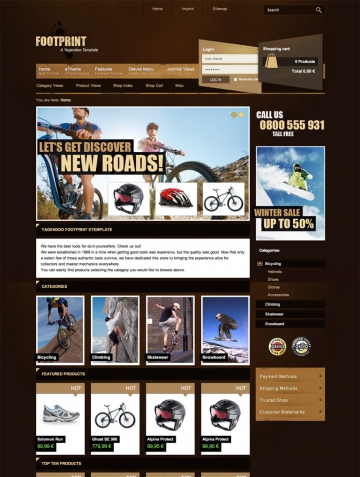
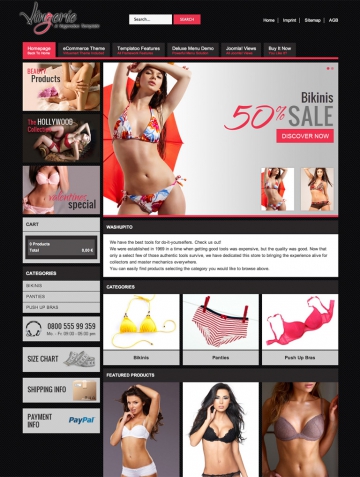
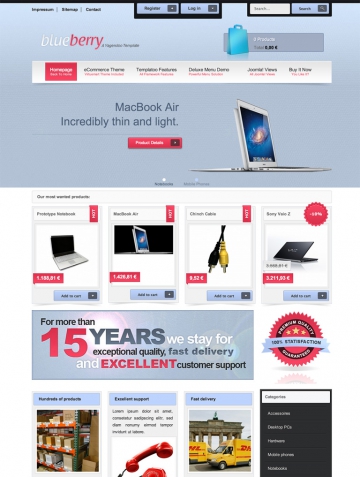
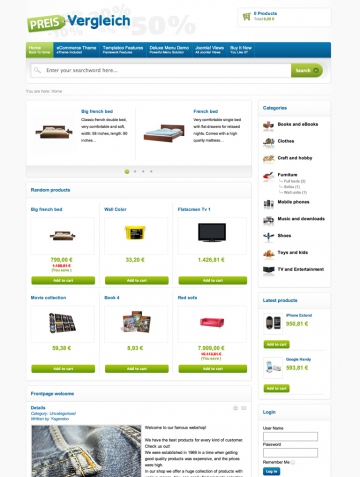
On the right, you see a possible view of the module. There are many configuration options which will be presented in detail in the following. You can choose, for example, a graphic display for discounted products or sold-out products. You can freely choose the display.
It is possible to enable or disable almost all elements in Yagendoo Virtuemart, e.g. the SKU, the description, the images.
You can set which products will be displayed and in which order, thereby targeting your products.
3. Basic Configuration of the Yagendoo Virtuemart Showcase Module
In your Virtuemart backend, navigate to the menu item Extensions -> Module. Here, you will find the "Yagendoo Virtuemart Showcase Products" module.
Amongst others, you can make the changes mentioned above here. Next to the module suffix, you find an input option for the number of columns in which the products are shown.
In the next step, you can select the IDs of the products that are to be displayed. Separate the IDs with a comma. The products will be displayed in the order that you have set here. If you enter any one ID twice, the product will also be displayed twice.
Now you have the following selection fields for enabling and disabling the following elements: the SKU, the short description, the price, the discount (if existing), the Addtocart button (button to add the product to the cart), the manufacturer, and the seller.
As next basic setting of the products to be presented, you can select whether you want to show the product image, as well as its placement and its size.
4. Enhanced Configuration of the Yagendoo Virtuemart Showcase Module
In the basic module parameters, you can find the enhanced parameters.
First, you enter whether you want to display the image for the discount (badge). Then you can select the badge.
Afterwards, you can decide whether you want to show the sold-out badge and the badge to be used. By default, only one exists. If you want to create and use your own badges, please check the FAQs.
5. FAQs
The Yagendoo Virtuemart Module for products to be presented does not look good and seems to be messed up.
It might happen that the template of your Joomla website overwrites the settings of the module.
The following trick might help you: Use FTP to download the main CSS file (often called "template.css") in the folder for css files (often called "css", "style" or "styles") in the /templates/YOUR-TEMPLATE/ folder.
Also, download the yagendoo.css in the modules/mod_yagendoo_vm_showcase/assets/css folder.
Copy everything from the Yagendoo CSS to the end of the template CSS. If this does not work, repeat the process with other CSS files of your template. Afterwards, re-upload the changed template CSS file to the server.
This trick can also help you with other modules and components if they are not displayed correctly.
I would like to add my own badge for discounts. What do I do?
You need to execute the following two steps:
1. Copy the new badge: Copy the image you have created (in PNG format) to modules/mod_yagendoo_vm_showcase/assets/img/badge_discount. Ensure that the name of your image file does not contain special characters (e.g. empty spaces).
2. Change the code: If you now select this image via the module parameters (it will be detected automatically), you will probably find that the placement and the angle of the writing on the image are incorrect.
You can make changes in yagendoo_image.php in the modules/mod_yagendoo_vm_showcase/lib/ directory on lines 84-86. In the following, you see these lines:
Simply change the name of the image in line 84. In line 85, the first value (30) stands for the font size, the second value (45) for the angle, the third value (30) for the distance to the left and the fourth value (90) for the distance from the top. You might have to play around with these parameters to achieve the correct display. Do not forget to re-upload the changed file to the server.
I would like to add my own "sold-out" badge. What do I do?
This is pretty simple. Copy the desired image to modules/mod_yagendoo_vm_showcase/assets/img/en (for English) and any language you wish. German, for example, would be in the folder modules/mod_yagendoo_vm_showcase/assets/img/de. Thus, you can create the badge in several languages. Please ensure that the image has the same name in all directories.
When I try to install the module, I get a white screen headed "-1- an error occurred" and below "Unable to copy selected file."
Uninstall the module by browsing to the menu item Add-ons>Install/Uninstall and to the module tab therein. Here, select the module and uninstall it. Now re-install the module.